On August 18th, 1940—later known as The Hardest Day of the Battle of Britain—17-year-old probationer nurse J.H. Allen (née Banks) was just 18 days into her first posting at Oxted and Limpsfield Cottage Hospital when the sky above Surrey erupted into combat. She watched as a German Dornier and a British Hurricane clashed overhead, their fates sealed above Titsey Hill and Hurst Green. What followed was a vivid baptism into wartime nursing that would shape her early adult life and remain etched in memory forever.
In this deeply personal and richly detailed account, Allen recalls the extraordinary experiences of nursing during one of Britain’s most perilous times—treating Dunkirk survivors, civilian air raid casualties, and even a captured German pilot who offered her his Iron Cross and a chilling warning of gas attacks to come. Life at the hospital, nestled at the foot of the North Downs, brought moments of quiet heroism, close calls during bombing raids, and even a chance encounter with King George VI as he reviewed troops before their departure.
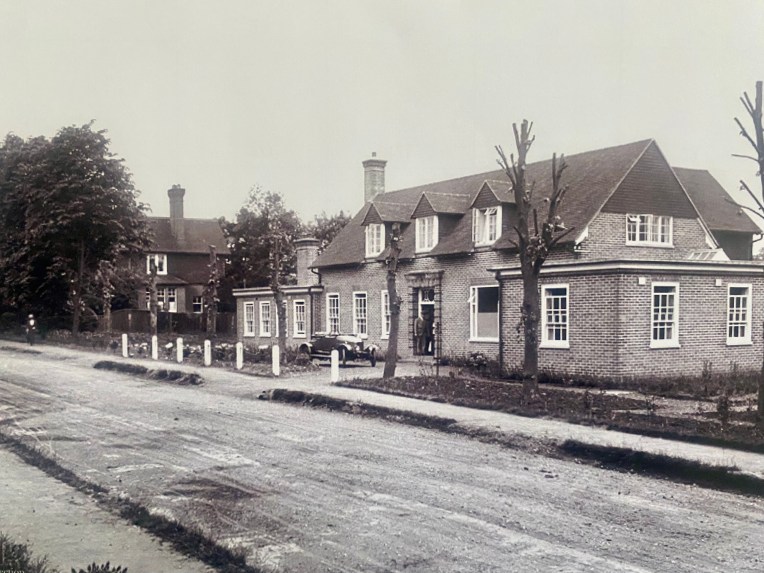
The original site of the Oxted & Limpsfield Cottage Hospital (later called Memorial Hospital) was in Gresham Road, but moved to Eastlands Way, off Gordons way in 1939. There are recorded instances of both Allied and German air crew being taken to the hospital during the early war years in The Battle of Britain.
One particular ‘Dog fight’ is recounted on a BBC site ‘WW2 Peoples War’ in which it tells of the crew of a German Dornier bomber crashing in Hurst Green. There was also a Messerschmidt crash on Limpsfield Common and a recorded fatal landing of a parachuted German pilot in Limpsfield Village.
“August 18th 1940 was a Sunday. We were having lunch when we realised that there was a “dog-fight” going on. We left our lunch and went out into the grounds, to see a terrific “dog-fight”, the worst we had seen so far. A Dornier shot a Hurricane down in flames – the pilot, Harry Newton, baled out over Titsey Hill direction. We heard later that a Dornier had crashed at Hurst Green. I had been a probationer nurse at Oxted and Limpsfield Cottage Hospital for 18 days, having left school earlier in the year, aged 17yrs.
On Sundays, we had a half-day off-duty. That day, a colleague and I walked down to Casualty. There we saw the pilot’s jacket, etc. He was in theatre. We heard later that a lady from Hurst Green, where a Dornier had crashed, was treated at the hospital for minor burns. I started nursing on August 1st, 1940 and signed on to stay for two years. This was a modern 40-bed cottage hospital, at the foot of the North Downs.
An army convoy, driving along the road on top of the Downs, was hit by enemy bombs. Casualties came to our hospital, one with severe facial injuries. A Harley Street ENT specialist on site was able to see to the casualties. One night, a German pilot arrived by ambulance. The night sister went out to see him. He wanted to give her his iron cross and told her to always carry her gas mask. He had been told they were going to gas us. I think he was admitted to a hospital in Redhill, Surrey, where they had special units for the military. We had civilian air raid casualties, suffering severe shock, burns, eye injuries – possibly due to the blast – and fractures.
I remember the young soldier from Dunkirk, who asked “Where were the RAF?”.
Once when on night duty, sitting at the table on the men’s ward, a stick of bombs were dropped very near to the hospital. The only damage was a cracked window in the kitchen of the women’s ward. Those patients, who were able to, were out of their beds and underneath them. “Nurse, get down!” I stayed put but I did go to each patient to see if they were all right. When St Thomas’s hospital in London was bombed, (we learned later that the bombs were intended for the House of Commons) some patients were sent to their local hospitals.
The patient we had from St Thomas’s told us that he was on the operating table and it bounced up to the ceiling and down again during the raid! The highlight for me was once when I had been on night duty. We had to be in bed by 12 midday. Two of us walked down to the shops for a coffee and cake. We could not buy cakes, biscuits etc because the hospital had our ration books. We began to walk back to the hospital, when we saw some outriders, so we walked back towards the recreation ground where many troops were lined up. We thought perhaps Churchill was coming, as he only lived four miles away at Westerham.
We stayed by the Hoskins Hotel, opposite the police and the recreation ground. A limousine drew up – out of it stepped His Majesty King George VI – amazing! He was to review the troops before they went abroad. Back at the hospital, we told them we had seen the King. Nobody believed us! We were all in this war together – working long hours – stressful and sad at times. Everyone gave of their best. Years later we met up for reunions.
I left Oxted Hospital in March 1943 and started my SRN training at the East Surrey Hospital, Redhill. Three years later, I was a state registered nurse. “To heal sometimes, to comfort always”. In 1981, I was invited to a reunion at Kenley. Among those attending was Harry Newton and some of the crew of the Dornier that had shot him down. Gunther Unger and Franz Bergmann had survived.
The Dornier came down in the “drink” – they were rescued after three hours of nightmare conditions – freezing cold and soaking wet. ”
Joyce Helen Allen (nee Banks)
The BBC asked the public to contribute their memories of World War Two to a website between June 2003 and January 2006. The website, now archived, contains 47,000 fascinating stories and 15,000 images https://www.bbc.co.uk/history/ww2peopleswar/.
Discover more from Limpsfield, Surrey
Subscribe to get the latest posts sent to your email.
