Limpsfield Village, the Common and Chart is an area steeped in history—from its Domesday origins and medieval timber-framed buildings to its 19th-century convalescent homes, Arts and Crafts churches, Roman roads, and wartime heritage.
St Peter’s churchyard is a significant resting place for celebrated musicians and local notables, while Limpsfield Chart and Common offer insight into centuries of rural life, industry, and community stewardship.
🏘️ Limpsfield Village
- Early mentions & Domesday: Limpsfield appears in the Domesday Book (1086) under the name Limenesfeld, held by the Abbot of Battle Abbey. It then had a church, mill, plough teams, woodland, quarries, and hawk’s nests.
- Historic architecture: The parish contains around 20 medieval buildings and over 89 listed buildings—including many 16th‑ and 17th‑century buildings, such as Detillens House, Forge Cottages, Tenchleys, Whinchat Cottage and Old Court Cottage (dating from ~1200 AD).
- Titsey Estate connection: Many large 18th and 19th‑century houses—including convalescent and children’s homes—were part of or are still owned by the Titsey Estate, whose seat at Titsey Place dates to the 16th century and is still held in trust today.
⛪ St Peter’s Church & Churchyard
- Church origins: The Church of St Peter dates from the late 12th century, built of ironstone rubble with a 16th‑century porch and extensively renovated in the 19th century. It is a Grade I listed building.
- Architectural highlights: Features include a 12th‑century tower, 13th‑century chancel and chapel, 16th‑century south porch, and 19th-century north aisle, plus the final stained glass window by John David Hayward depicting St Cecilia.
- Notable burials:
- Composer Frederick Delius, and his wife Jelka, buried here per his wish to lie in a rural south England churchyard.
- Conductor Sir Thomas Beecham, cellist Beatrice Harrison, conductor Norman Del Mar, clarinettist Jack Brymer, and Australian pianist Dr Eileen Joyce are also interred in the churchyard.
- Additionally, the Hon. Mountstuart Elphinstone (1779–1859) and Sir John Elphinstone (1807–1860), colonial administrators, are buried beneath the west window St Peter’s Church.
- James Haldane Stewart (1778–1854), former rector, also lies here.
- Folklore: A man buried with an acorn in his mouth said that if an oak grew it would prove his resurrection—and today a monkey-puzzle tree stands there instead St Peter’s Church.
- WWII – German pilot who buried himself (not quite literally, but almost) and his parachute in St Peter’s Churchyard.
🏡 Limpsfield Chart
- Overview: A small settlement centred on The Carpenters Arms (an early coaching inn) and St Andrew’s Church, built in Arts and Crafts style in 1896 as a daughter church to St Peter’s.
- Roman heritage: The remains of the London–Lewes Way (a Roman road) run through High Chart’s woodland. [Click here for our article on the Roman invasion of Limpsfield Chart by Sir Richard Stilgoe.]
- Buildings & homes: Alongside the pub and church, there are historic structures like Mill House, The Salt Box, and several grand convalescent homes such as Caxton House and Trevereux Place (later Marie Curie Centre) built in the 19th century, as well as Trevereux Manor.
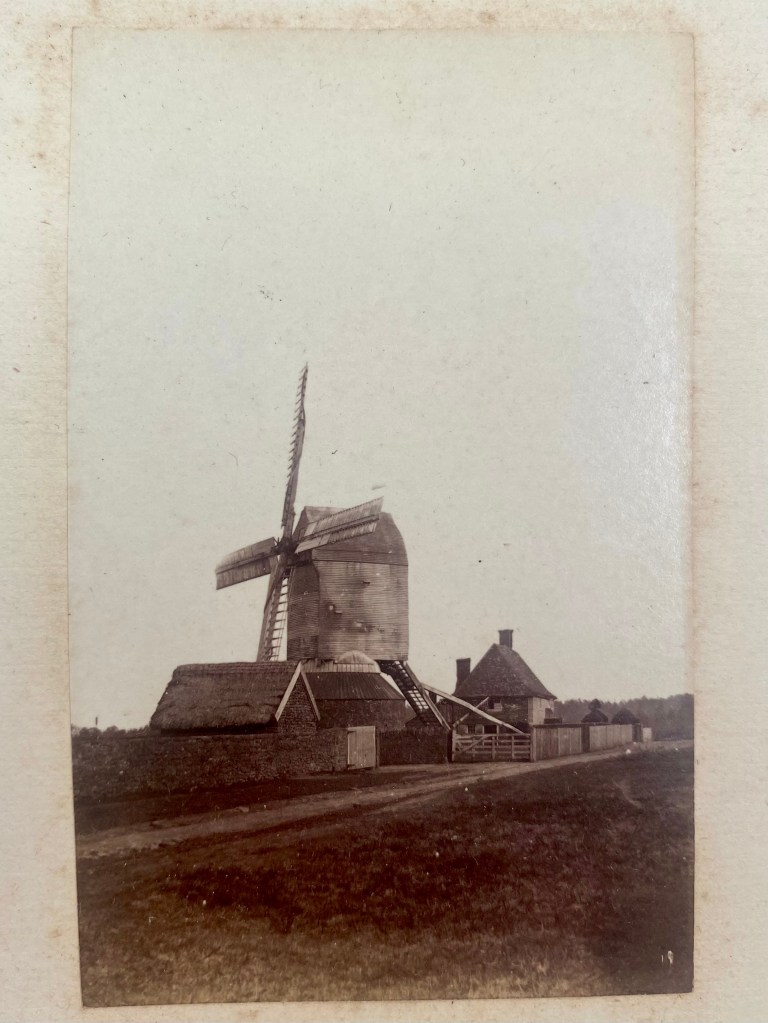
- Windmill history: The old “Post Mill” (circa 1817), built on Mill Lane, was the only windmill in Surrey with clockwise‑turning sails.
- Local environment: Limpsfield Chart’s common land—woodland and heath—remains largely owned by the National Trust and Titsey Foundation and was historically used for grazing into the 20th century.
🌿 Limpsfield Common
- Origins & medieval use: Formerly the “waste of the Manor of Limpsfield,” Common land was used historically for grazing, stone/quarry material and firewood. The manor, post‑Battle Abbey dissolution, passed into private hands and the Common was gifted to the National Trust in 1972 by Major Richard Leveson‑Gower.
- Industry: Medieval Limpsfield Ware pottery kilns (hence Brick Kiln Lane) and later Victorian brick‑works operated nearby; remnants still visible. Find out more at nationaltrust.org.uk and on the Limpsfield Way pages of Limpsfield Parish Council’s website.
- WWII heritage: Air‑raid shelters built at the start of WWII to protect schoolchildren from nearby Limpsfield School; one was restored in 2006. A remnant Spigot Mortar anti‑tank mount remains visible on the Common. These are owned and managed by the National Trust and Friends of Limpsfield Common who regularly host open days.
- Recreation & nature: Limpsfield Chart Golf Club (founded 1889) and local cricket clubs offer recreation. The common supports rare heathland flora and fauna including heather, gorse, deer, woodpeckers and more – find out more on the Friends of Limpsfield Common website.
- Modern stewardship: Management by the National Trust with local committees and volunteers helps maintain this ecological and historical landscape.
More Facts
📍 Bluehouse Lane – Limpsfield Grange School
- Limpsfield Grange School, at 89 Bluehouse Lane, opened in 1953 originally as an open‑air school for girls with respiratory conditions; it later became a state‑funded boarding school for autistic girls aged 11–16, unique in the UK Wikipedia.
- Housed in what is believed to be a 19th-century manor-style building, the school includes an on-site swimming pool. It currently educates around 94 pupils and was featured in a 2015 ITV documentary, Girls with Autism Wikipedia.
🌉 Bridge & Footbridge over the River Eden
- A ford and footbridge cross the River Eden near Pitchfont Lane; this crossing, along with an adjacent vehicular bridge, marks historic local routes, possibly part of a prehistoric trackway Wikipedia.
🏡 Skinners Farm (corner of Water Lane & Bluehouse Lane)
- Skinners Farm once stood at the junction with Water Lane and is reputed to be the place where George Eliot stayed while writing The Mill on the Floss and Adam Bede. The farmhouse became unoccupied, was unsafe, and eventually demolished. A low brick wall in front of the current houses marks the original boundary, lowered per planning conditions; a barn once stood on Staddle stones on site.
🚶♂️ Detillens Lane & Detillens House / Cottage
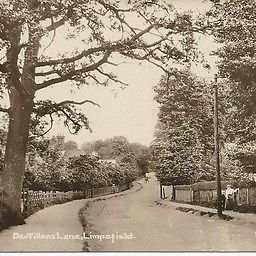
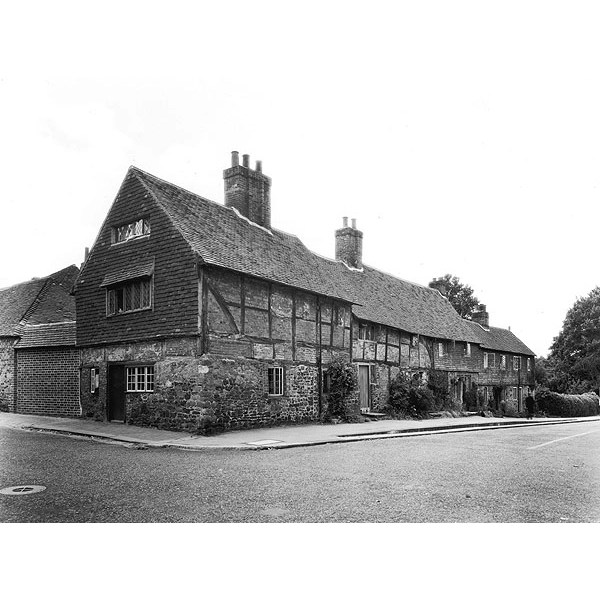
- Nos. 48–50 Detillens Lane formed originally two cottages (18th–early 19th century) built of sandstone and ironstone rubble on the ground floor with tile‑hung first floors. Their gardens once extended across what is now the road, the remains of which are at Detillens corner (where the compost bins are).
- Detillens Cottage (now No. 1 High Street / No. 58 Detillens Lane) dates from the 16th century, timber‑framed on a rubblestone plinth, with whitewashed brick and tile‑hung first floor. It is Grade II* listed Historic England.
- Detillens House is originally a 15th-century timber‑framed hall house, with a front added in 1736, Grade II* listed. Inside are Tudor fireplaces and an octagonal crown post; previously known as Millcroft in 1718, it appears to have been a miller’s house from circa 1480, with grains still visible in its timbers. Later home to Eugenia Stanhope Historic EnglandBritish Listed Buildings.
🎾 Limpsfield Club (sports club, near Detillens area)
- Founded c. 1899–1900, initially offering tennis and croquet on grass courts with a thatched pavilion leased from the Leveson Gore family (Titsey).
- In 1910, grass courts were partially replaced by red shale hard courts, and a badminton hall was added. During WWI, army officers were honorary members and in 1921 a motor entrance was introduced.
- The badminton hall was commandeered by Limpsfield School from 1942 to 1955 as a canteen. The club continued expanding—adding squash and sports halls, replacing all grass tennis courts—and still thrives into the 21st century Wikipedia.
🏠 High Street
- School Cottage (formerly Grangebrook), built in 1832 as a girls and infants school, later extended for boys—likely the National School of Limpsfield.
- Church Cottage, around 1700 with early 19th-century alterations: timber‑framed with rendered brick front, lead‑lined box gutter; now Grade II listed limpsfieldgrange.co.ukHistoric England.
- Manor House (not actually a manor): built around 1775, later used as Manor House School from 1897 to 1969, now converted to flats. Notable alumni include Gillian Tindall, Diana Rowden, Mary Soames Wikipedia.
- The Bull Inn: a 17th‑century building formerly known as the Anchor & Chequer, owned in 1892 by Bushell & Co of Westerham; rubble walls from the original remain around today’s car park.
- Miles Butcher’s shop: the site goes back to at least 1424, described as a “slaying house”; contains a distinctive dragon post at its south end.
- Redfern: 19th‑century house, later home of Richard Church from 1918.
- Jarrett’s Shop: part of a circa 1500 hall house.
- Old Lodge: originally the lodge to Hookwood Park, later used as school accommodation by Manor House School.
⛪ St Peter’s Church & Churchyard
- The tower dates from 1180, and the church was significantly restored in 1872; the 16th-century porch, wooden shingled spire and internal features (e.g. a sacred‑bread oven recess) survive. The church holds monuments to the Teulon and Stanhope families Wikipedia; Wikipedia.
- Churchyard access via a 15th-century lych gate. Burials include Frederick Delius (composer) near an ancient yew tree with his wife Jelka, and also Sir Thomas Beecham, Eileen Joyce, Norman Del Mar, and Jack Brymer. A granite boulder from Zimbabwe’s Matopo Hills marks part of the site, and a war memorial stands just outside the main church door Wikipedia.
🧱 Other Historic Features
- Poors’ Allotments: historic allotments behind the church; now part of North Down Nursery.
- The Rectory: red brick residence was struck by lightning in 1711.
- The Barn: a former tithe barn with ancient timber frame, clad in 1841, destroyed by fire in 2000.
- St Peter’s Halls: church hall built in 1969 as a temporary timber structure; transferred to the Diocese in 1985 – and still in use.
- Old Sawmills: the former sawmill site sat behind what is now a modern house; gateposts remain. The timbers were reused in Oxted’s Barn Theatre, with dendrochronology dating them to 1363–1433, suggesting a barn built in 1434.
- Pitchfont Lane: once possibly part of a prehistoric route.
- Sandy Lane – Hookwood House: a 19th‑century stock brick house with a buried ice‑house discovered in 1969, built of sandstone and ironstone, likely dating from the late 17th century.
- Titsey Road: the Limpsfield–Croydon route was turnpiked in 1813.
- The Boys’ Home on Titsey Road: was built in 1886, and run by Oxford House Settlement accommodating about a dozen inner‑city boys for outdoor stays.
Read more history stories HERE.
Discover more from Limpsfield, Surrey
Subscribe to get the latest posts sent to your email.
