Following on from our article on Mary Emma Cox’s Victorian Photo Album, in this brilliant guest article, Limpsfield Chart resident and national treasure, Richard Stilgoe traces the colourful and often chaotic history of Trevereux Manor—the grand old house whose name has baffled spellers for centuries.
Eschewing a dry account of architectural changes, Stilgoe focuses on the people who shaped its story, from Roman settlers and medieval knights to Jane Austen-style romances and fifties pop stars. Through tales of wartime sieges, thunderstorm courtships, and Rolls-Royce rebuilds, we meet a cast as diverse as the house’s many spellings. With warmth and wit, Stilgoe takes us from the Manor’s earliest days to its near-destruction in a dramatic 1989 fire, and finally to its loving restoration by his own family—proof that while the spelling of Trevereux may remain tricky, its charm is undebatable.
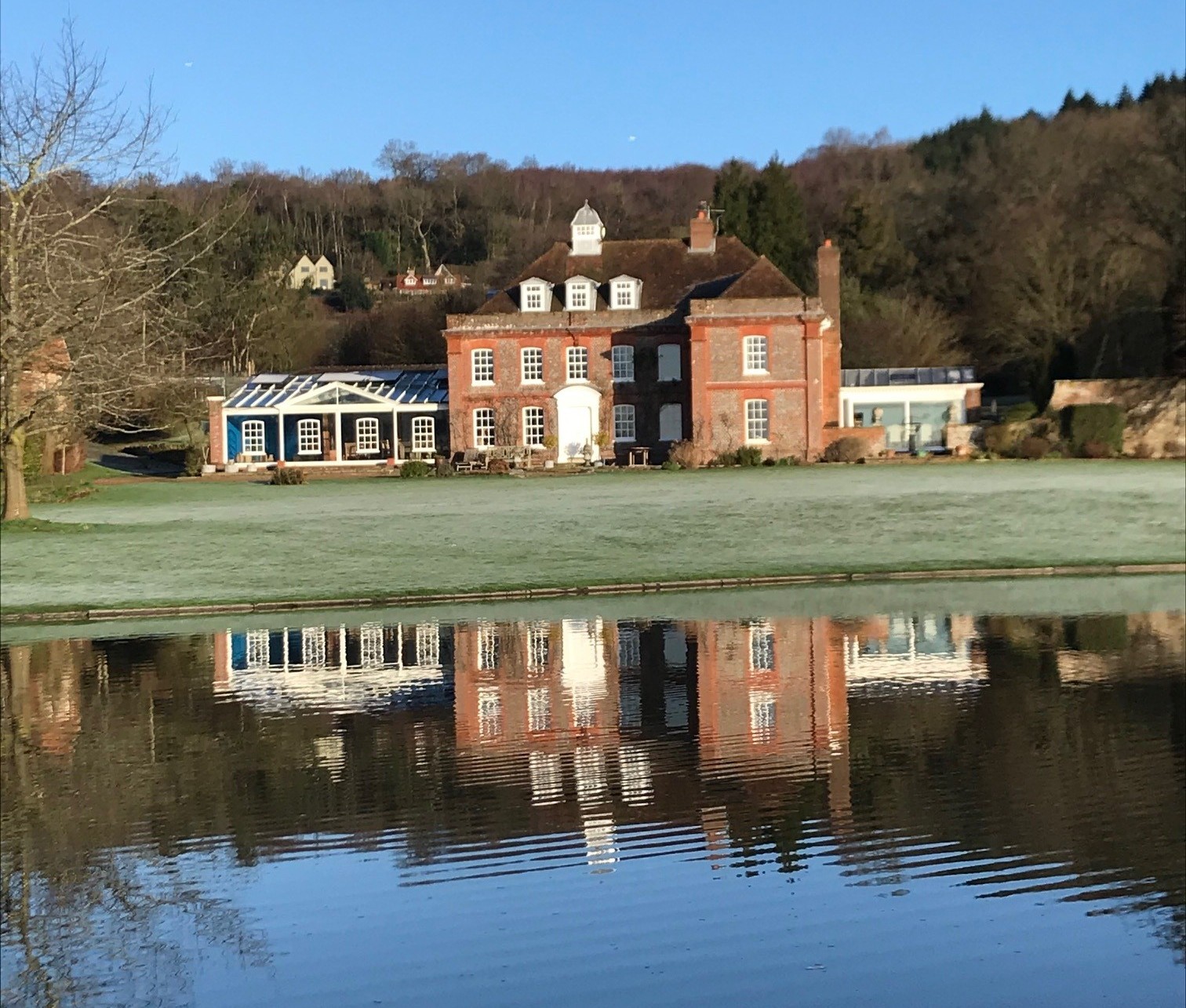
Trevereux – the house they cannot spell
by Richard Stilgoe
I spend a lot of my life spelling Trevereux’s name over the phone, and I’m obviously not the first to have this problem. Since 1424 it has been called variously Treveraks, Trivyrocks,Trewrock, Treverook and Tiverix until in 1788 it settled on Trevereux, this being a fancy Frenchified name with no historical evidence behind it. Later on, someone added ‘Manor’ to make it sound even grander.
Now I could plod through a history of West wings, East wings and cupolas and loggias, and very dull it would be too. A history of a house is the history of the people who lived in it, so that’s what this is going to be. We know more about some of them than others.
TREVERUS MAXIMUS. All, right, I made him up. But the county archaeologists are convinced there was a Roman Villa on this site, next to the Vanguard way that travels from Lewes to Woolwich via the Chart. We have dug up lots of shards of Roman pots in the fields, and a beautiful little bronze of Mercury carried as a good luck charm. Severus Maximus, incidentally, is real and significant as the answer to a quiz question – he is the only black African Roman Emperor and was also governor of Britain for some time.
THOMAS TREVARAK. He’s real and probably came from Trevarrack in Cornwall. In July 1418 Henry V, riding the success of Agincourt, sends him off to France with 58 men at arms and 120 archers to the siege of Rouen, which had just started. By Christmas 12,000 people had been starved to death, Rouen had fallen, and Normandy was back under English rule. In 1424 Thomas Trevarak is safely living in Limensfeld, and in 1540 Thomas Trivyrock – presumably a descendant – is in the same place. The house would have been named after them.
ISAAC BURGES in 1664 lives here and pays tax on five hearths – the Hearth Tax was a new measure to pay for Charles II’s expensive habits. The Burges family built the house that stood here for the next three hundred years and were here until 1817. During that time, round about 1709, they added the beautiful brick front wall which Annabel and I fell for when we first saw the house in 1983. In 1794 Robert Burges left the house to his niece Mary Sandiland, and in 1801 the Sandilands paid £20,000 (a huge sum then – and quite a lot still) for the Manor of Langhurst, and that may be why the word Manor got added to the name.

HENRY COX. (1787-1877) Henry Cox bought Trevereux in 1817, when he was thirty and doing pretty well. This was a great time to be a farmer – the demands of the hungry army in the wars against Napoleon had made farmers rich, and Henry was expanding from Farningham in Kent. He wrote to his neighbour Mr Brooker, “On Wednesday last I entered into an agreement for the purchase of the estate at Trevereux for £5,600 which some of my friends think is not dear, whether it is or not I like the place and am satisfied.” His friends may have thought it ‘not dear’ but the current value of £5,600 is an awful lot. From 1808 until 1849 he kept a journal of ‘Natural appearances and occurrences in Farming’. Here are some extracts:
1818. May 8, a deluge of rain fell, after which no more fell at or near Trevereux till September 5, being 17 weeks and 1 day, during which all vegetation was completely burnt up.
1829. Rain more or less every day from June 16 to September20, being 96 days.
1839. At harvest this year, a single grain of wheat, planted in October 1838 in my garden, without extra cultivation, produced 2,800 grains of wheat on 64 straws.
1849. April 16 to 20, much snow and frost, the Westerham Coach was buried and left all night on Titsey Hill, April 19th.
Henry had no male heir, and nor did his three brothers. So his daughter, Mary Emma Cox, (1847 – 1924) would have been pretty well set up – and thus a target for…
LT.COL. WALTER TUCKFIELD GOLDSWORTHY. Miss Cox first encountered not Walter, but his luggage, on Westerham station. It was labelled ‘ LT.Col Goldsworthy, unattached.’ Miss Cox was scandalised by this blatant advertisement of his marital status (not realising that it meant that he was not a member of a particular regiment), so when the penniless soldier called at Trevereux he had an uphill struggle. In 1878, aged 41, he wrote an excellent Jane Austen-ish letter to his mother – “I think Miss Cox is a girl who is very clever and everything she takes in hand she will do well, but as she said herself she likes doing things in her own way. I imagine she would not like to marry into a poor family like ours.” He doesn’t give up, walking the four miles from Westerham through thunder and lightning on occasion, and eventually played his trump card, by arriving wearing his Irish Hussars’ uniform. Like so many before and since, Miss Cox could not resist. However, Walter was a good and honourable man and did not care to live in his wealthy wife’s house as ‘Miss Cox’s husband’. He became MP for Hammersmith, and Trevereux was let to one of his colleagues, the ex-M.P. for Wilton with the glorious name of Charles A’Court Repington. During his tenancy, or possibly that of his successor Mr. Carmichael Bruce, the huge addition to the west of the house was added, which Annabel and I demolished in 1991 after the fire. But before the fire came the roaring twenties and
MRS.ACKROYD. Mrs Ackroyd, mother of Reginald, Cyril and Geoffrey, had a chauffeur called Ernest Cooke, whose daughter came to see us. She remembers Mr Cooke dismantling the Rolls-Royce Silver Ghost every winter. She remembers Mr.Gibbs the butler, Isabel Brown the lady’s maid and Mrs Brogan the cook. In particular, she remembers Mrs. Brogan making her signature chocolate mocha cake for Douglas Bader, who had landed his plane in the field south of the house in order to call on Diana Boyd-Rochfort, Mrs Ackroyd’s grand-daughter. Such glamour!

From 1946 the house seems to have been divided into two halves and let to various people, several of whom have told me of their happy memories of their time here. Mr. And Mrs George Bruce were in the front of the house from 1955-62, followed by the Stephensons. Donald Stephenson started the BBC Arab service at Bush House. The Hennings were in the back half of the house. Mr and Mrs Eric Anderson were in the South Lodge in the ‘50’s, and a Mrs Evelyn Forbes had the Western cottage at that time. The cottage next door – the eastern one – was let in the fifties to Bernard and Laura Ashley (“so poor they had to drink out of jamjars”, according to one report) and then to Gary Miller, a fifties pop star with nine hits to his name, including The Garden of Eden and Robin Hood.
In 1972 the Goldsworthys, who by now were living in Hurst Farm across the valley, sold the estate to Donald Martin Betts. He made many alterations and improvements, and in the mid-seventies sold it to Sheikh Ajeeb and his brother Sheikh Bagedo from Saudi Arabia. England is not always good at taking other cultures to its heart, and the fact that the brace of Sheikhs spent very little time here, and when they were here would drive live sheep into the kitchen and slaughter them in the approved Hal-al way, did not endear them to the locals. (Meat does not keep long in hot countries, so this a sensible practice in Saudi Arabia, but outrageous to people who like their meat shrink-wrapped and unrecognisable from Morrison’s). By 1983 the house was on the market, and Annabel and I – who at that stage could not possibly afford it – went to inspect. It was unloved, and the garden had disappeared, but we went away and dreamed about it.
At 0426 hours on 7th March 1989 the fire brigade received an emergency call. Trevereux manor was on fire, the flames visible for miles around. Twelve members of the Ajeeb family escaped, but none thought to warn their servant Abdelkader Tahir, who died in his second-floor attic room. All that remained later that day was the 1900 extension, the stone wall to the East and the beautiful eighteenth century brick front. All trace of Thomas Trevarak’s old timber-framed house was gone.
Annabel and I bought the ruins in 1991, and with the help of Phil and Sandra Slegg (Phil remembered scrumping apples in the orchard as a boy) we re-built first the coach-house then the Manor. We demolished the 1900 extension, aiming to return the main house to what it looked like in the well-known 1848 engraving – though we added glass extensions to the east and west. This took a long time, and appeared to be never-ending, but luckily my daughter Jemima met a nice young man called Jim, so we were able to name a wedding day by which time the house must be finished. On September 17th, 1994, Phil and Sandra and the builders backed out of the back door as the guests arrived through the front, and we have lived here happily ever since. Our daughter Holly was married from the house in 2006, and our son Joe in 2012. All thirteen grandchildren come and play in the garden.
We love the place as much as Isaac Burges and Henry Cox and the Goldsworthys and Mrs Ackroyd must have– though life here has one significant difference; I have listed Mrs Ackroyd’s staff of four, all living in. Henry Cox in 1871 had Mary the cook, Jemima the lady’s maid, Anne the parlour maid, Sarah the Kitchen maid and George the coachman. The Sheikh had lots of staff, living in a dormitory above the stables in the coach house. Annabel and I had one day a week of Fred and Mick in the Garden, and one afternoon a week of Janet doing the cleaning. But we do have a dishwasher and a washing machine, which weren’t available to the Coxes, the Ackroyds or Treverus Maximus.
Richard Stilgoe
Discover more from Limpsfield, Surrey
Subscribe to get the latest posts sent to your email.
